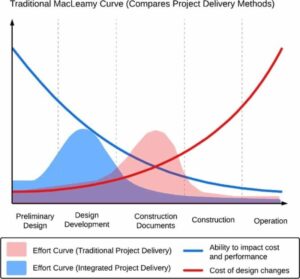

You’re in the middle of Construction Documents, looking at the energy model, and realize you are short of a LEED Gold rating.
The immediate reaction? Try to squeeze points out of high-efficiency HVAC equipment or slap on extra solar panels. But by then, it’s too late. The budget is locked, the building footprint is set, and you are fighting a losing battle against the laws of physics.
Under LEED v5, chasing points at the finish line is no longer an option.
The updated Minimum Energy Performance prerequisite raises the baseline entirely (aligning with stricter decarbonization targets). To build a Gold-worthy asset, we can no longer rely on mechanical band-aids to fix architectural flaws.
The secret to Gold isn’t more expensive equipment. It’s timing.
To hit the mark, your system selection must follow a strict, emotionally intelligent design timeline:
🔹The Concept & Pre-Design Stage (The Soul): This is where you fight for the envelope. Before picking a single chiller, focus on passive design massing, orientation, window-to-wall ratios, and shading. If the building doesn’t protect itself from the elements, your HVAC will always overwork.
🔹 Schematic Design Stage (The Backbone): This is the ultimate fork in the road. Do not wait to select your central plants, ventilation strategies, and energy recovery systems. Run early, iterative energy mock-ups now. Choosing between VRF, chilled beams, or heat pumps must happen here while the design is still fluid enough to absorb the choice.
🔹 Design Development Stage (The Muscle): Only when the architecture and major systems are locked do you dive into component efficiency. This is the stage for fine-tuning lighting power densities, selecting high-performance glazing, specifying premium-efficiency motors, and integrating smart building controls.
When we wait until the end of design to treat energy efficiency as a “checklist item,” we compromise both our budget and our architectural vision.
LEED v5 is forcing the industry to return to what design was always meant to be: a deeply collaborative, deeply intentional practice from day one.
Let’s stop engineering solutions to fix bad architectural choices. Let’s design them right from the start.
Where is your team currently introducing energy modeling into the lifecycle? Are you modeling to inform design, or just to verify it? Let’s discuss or visit our website info@conserveconsultants.com or WhatsApp +9190030 97071.
U.S. Green Building Council |GBCI India