
One of the common assumptions around embodied carbon is:
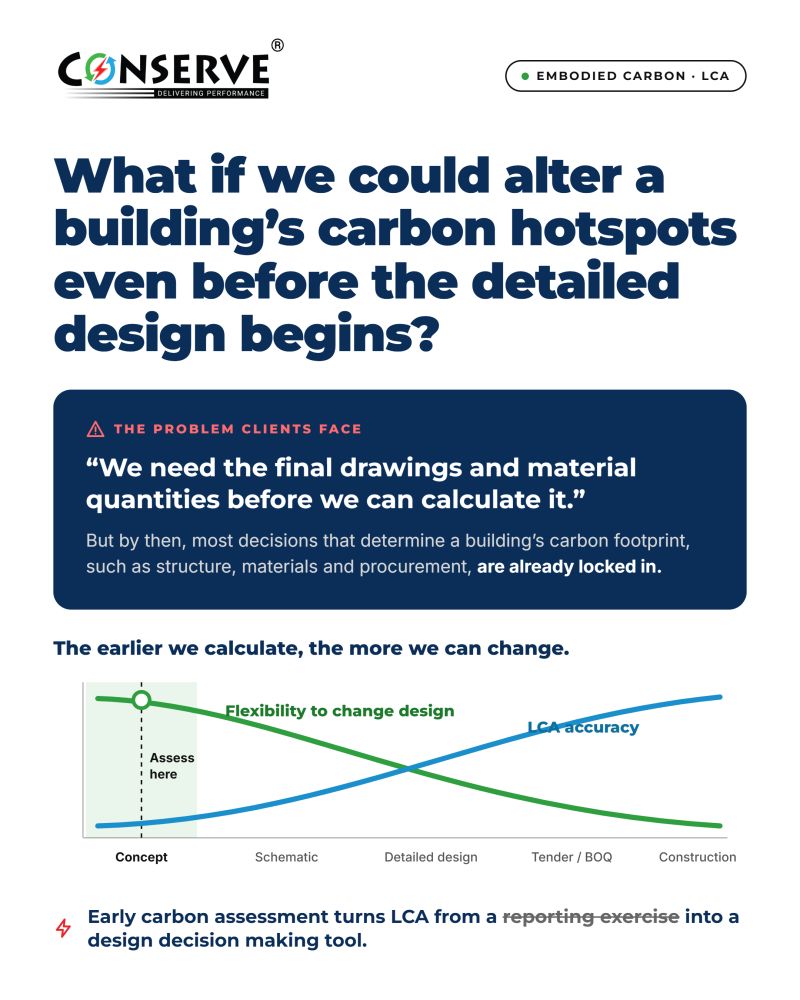
“We need the final drawings and material quantities before we can calculate it.”
But by then, many of the decisions that determine a building’s carbon footprint have already been made.
The earlier we calculate, the greater our ability to change the outcome.
Early-stage data may not be perfect, but it is sufficient to estimate material quantities, compare alternatives and identify major carbon hotspots. As the design progresses, LCA accuracy increases—but the flexibility to change structural systems, materials and procurement choices decreases.
Early embodied carbon assessment therefore shifts LCA from a reporting exercise to a design decision-making tool.
Imagine a building development at concept stage, before detailed structural drawings are available, the project team could already start discussions with questions like:
🔹Which building elements are likely to become the largest carbon hotspots?
🔹 Should the design team focus first on concrete, reinforcement, façade or another material?
🔹 What embodied-carbon budget (kgCO₂e/m²) should the project carry into detailed design?
🔹 What are the alternative low-carbon materials that can be proposed in the tender stage?
These are much more valuable questions before the design is frozen than after the BOQ is prepared.
Our conventional sequence is often:
Design → BOQ → One-time LCA → Identify Carbon hotspots → Recommend alternatives during Construction → Report with assumptions
Perhaps the ideal sequence should be:
Concept → Preliminary Carbon Model → Identify Hotspots → Set Carbon Budget → Optimize Design → Detailed LCA → Track during construction → Compare with as-built LCA → Benchmarking → Improve future designs
This early embodied carbon assessment does not replace the detailed Whole Building LCA. Its purpose is different. It gives architects, structural engineers,
MEP teams, sustainability consultants, and developers an early carbon compass indicating where to investigate before committing to decisions that become progressively harder and more expensive to change.
The key insight is about when we choose to measure carbon & what we do with it.
Planning a sustainable building? Start measuring embodied carbon before the design is frozen.
At Conserve Consultants, we help project teams turn early-stage carbon insights into informed design decisions supporting material optimization, Whole Building LCA and low-carbon building strategies.
Let’s make carbon-conscious decisions from the very beginning.
Connect with us to explore how early embodied carbon assessment can support your next project. Visit: https://lnkd.in/dThYxcG2 or 9003097071 / info@conserveconsultants.com to start your sustainability journey today.

