
For years, BRSR has been treated as an ESG reporting exercise. From FY 2026, for the top 1,000 listed companies, that changes.
The question is no longer just whether a disclosure was made — it's whether it can be independently assured. That shift turns BRSR from a sustainability initiative into an enterprise-wide governance and internal controls exercise.
Based on our experience supporting companies through ESG reporting, BRSR implementation, and assurance preparedness, here are five mistakes to fix before assurance begins.
1. Treating BRSR as one team's job BRSR Core indicators need input from 8–10 functions, not just Sustainability or Company Secretarial. Without clear ownership, expect inconsistent data, duplicate requests, and delayed sign-offs.
→ Fix it: Build a responsibility matrix mapped to each disclosure, backed by a cross-functional governance committee with named data owners, reviewers, and approvers.
2. Collecting data without building an audit trail Most companies collect ESG data. Few retain the evidence to defend it — source, methodology, boundary, approvals, documentation, version history.
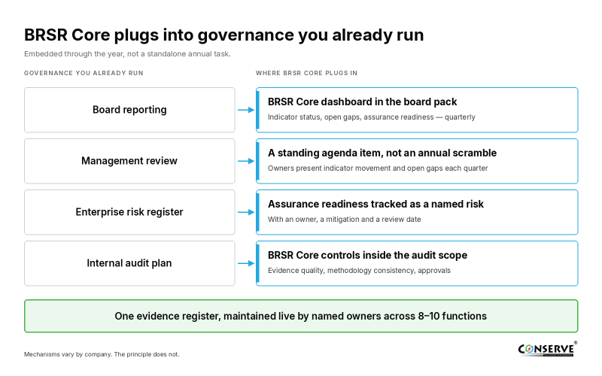
→ Fix it: Maintain an evidence register linking every BRSR Core indicator to its source records, owner, and calculation file. Govern the data, not just the disclosure — this is what separates compliant from assurance-ready.
3. Waiting until year-end to find data gaps Post year-close is when companies typically discover missing utility records, incomplete HR data, unsupported supplier inputs, and inconsistent plant-level methodologies — all hard to fix retrospectively.
→ Fix it: Review BRSR Core indicators and validate calculations quarterly from the current year, if you would be under the radar from next year. Close documentation gaps through the year, not during reporting season.
4. Assuming existing ESG data is assurance-ready Tracking energy, water, waste, emissions, and workforce data isn't enough. Assurance also tests consistency, internal controls, evidence quality, governance, and reproducibility.
→ Fix it: Run a readiness assessment covering methodologies, boundaries, evidence, and controls before the assurance provider steps in.
5. Treating BRSR as compliance, not governance The biggest missed opportunity. Companies that get the most from BRSR use it to strengthen data governance, controls, board oversight, and investor confidence — making assurance a validation, not a scramble. → Fix it: Embed BRSR into existing governance — internal audits, management reviews, risk registers, board reporting — rather than running it as a standalone annual task.
If you're preparing for BRSR Core assurance, now's the time to check whether your data, documentation, controls, and governance are truly ready.
Happy to connect if you'd like to talk through BRSR gap assessments, evidence management, mock assurance, or ESG data governance

