
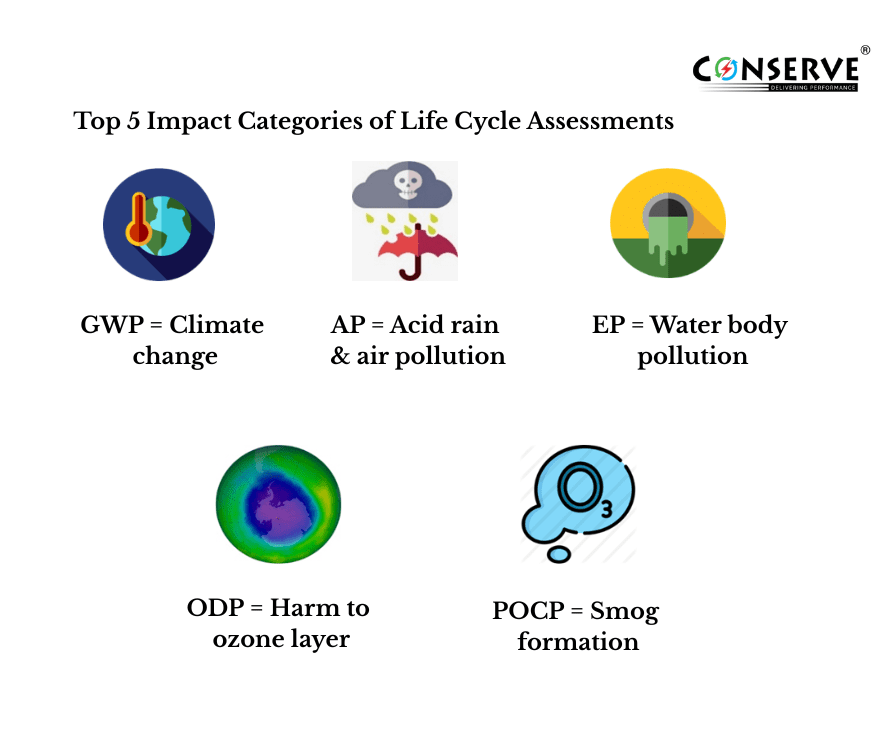
Life Cycle Assessments quantify environmental impacts across the full life cycle of products: raw materials, manufacturing process, transportation and distribution, product use phase including repair and maintenance required and the end-of-life scenarios.
Among many of the environmental impact indicators (results of LCA) available under EN 15804, ISO 14040/44, following are considered critical for companies to analyse and disclose:
1. Global Warming Potential (GWP)
Definition:
GWP measures how much heat a greenhouse gas traps in the atmosphere relative to CO₂ over a 100-year period. It represents the product’s contribution to global temperature rise, extreme weather risk, and long-term climate change. GWP is the core metric in Product Carbon Footprints (PCF) and Embodied Carbon calculations.
What it measures:
It captures the total climate impact of all greenhouse gas emissions generated during the product’s life cycle, such as, Fossil CO₂ from fuel combustion, CH₄ from materials, processes and wastes, N₂O from industrial reactions & processes, Fluorinated gases from refrigerants, Biogenic and land-use emissions etc. and is expressed as kg CO₂e.
Why it matters:
GWP determines embodied carbon locked up in materials & finished products, Required for global trade and green procurement, Product-level emissions for the end users’ specific Scope 3 categories.
2. Acidification Potential (AP)
Definition:
Acidification Potential quantifies emissions that form acid gases when released to air mainly SO₂, NOₓ, HCl, NH₃, etc. These gases mix with atmospheric moisture and create acid rain, which affects the Soil fertility, Forest health, Freshwater pH levels, Corrosion & reactions in Building materials, Human respiratory health.
What it measures:
AP highlights the environmental burden of combustion-heavy industries, chemical plants, coal-based energy, and materials manufacturing and is expressed as kg SO2e
Why it matters:
Highly relevant for industries such as Cement, Fertilizer, Chemical production, Iron, Steel & thermal process industries etc which are required to comply with industrial pollution control requirements, statutory regulations and environmental impact assessments.
3. Eutrophication Potential (EP)
Definition:
Eutrophication Potential measures the release of nutrients such as nitrogen and phosphorus into water bodies and soil. When excess nutrients enter lakes, rivers, or coastal zones, they result in Algae blooms, Reduced oxygen levels and biodiversity loss, Degraded water quality, Odor and toxicity issues.
What it measures:
EP indicates how a product contributes to water-body degradation, a critical issue in regions with high population density, high industrial development and is expressed as kg PO4e.
Why it matters:
Highly relevant for facilities which causes chemical effluents runoff or fertilizers runoff, process water or Wastewater discharge, residues, Improper solid waste handling etc that are required to comply with industrial pollution control requirements, statutory regulations and environmental impact assessments.
4. Ozone Depletion Potential (ODP)
Definition:
Ozone Depletion Potential measures the impact of certain chemicals on the stratospheric ozone layer, which protects Earth from harmful UV radiation. Substances like CFCs, HCFCs, Halons break down ozone molecules and this leads to Increased UV-B radiation reaching Earth, Higher skin cancer rates, Crop & plant damage, Marine ecosystem disturbance and Material degradation.
What it measures:
Impact of substances that deplete the ozone layer (CFCs, Halons, HCFCs) and is measured in kg CFC-11e.
Why it matters:
Important for industries using Refrigerants, Insulation foams, Specialty chemicals, older cooling systems and Cold chain logistics
5. Photochemical Ozone Creation Potential (POCP)
Definition:
POCP captures the formation of ground-level (tropospheric) ozone, commonly known as smog. This happens when VOCs (Volatile Organic Compounds), NOₓ, and hydrocarbons react under sunlight. Smog formation leads to Respiratory and cardiovascular health risks, Crop and vegetation damage, Reduced visibility and Urban heat island intensification.
What it measures:
Ground-level ozone creation (smog), driven by VOCs, NOₓ, and hydrocarbons. Measured in kg NMVOCe.
Why it matters:
Critical for Industries manufacturing & utilizing paints, adhesives, coatings, Solvents & Chemical plants, Petrochemical manufacturing, Urban construction projects, Transport & logistics, and other Manufacturing involving VOCs.
"Master LCA Impacts with Conserve Consultants Book Your Assessment Now" DM us, info@conserveconsultants.com or WhatsApp +9190030 97071. More details at

