
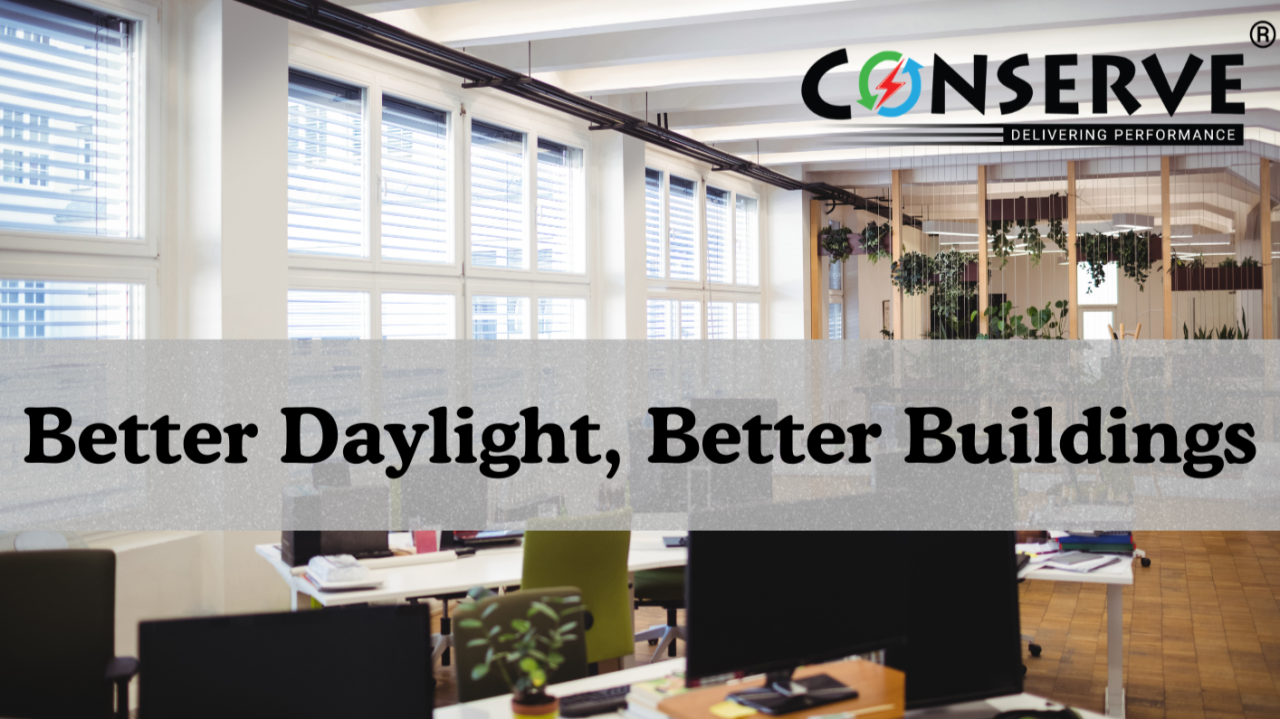
Better Daylight, Not More Daylight: How Data-Driven Design Improves Building Performance
“Many of us believe that more daylight always makes a building better, but that’s actually a myth.
Daylight is beneficial only when it is well-designed”
More Daylight Doesn’t Always Mean a Better Building
We often assume that the more natural light a building receives, the better it performs.
But that is only true when daylight is properly designed and controlled.
Natural daylight can make spaces feel open, comfortable and connected to the outdoors while reducing dependence on artificial lighting. However, poorly planned daylight can create glare, excessive heat gain, higher cooling demand and occupant discomfort.
The goal isn’t to bring in more daylight.
The goal is to bring in the right amount of daylight, in the right places, at the right time.
What Happens When Daylight Isn’t Designed Properly?
Poor daylight design can lead to:
- Excessive glare, making it difficult to work comfortably on screens.
- Solar heat gain that increases indoor temperatures.
- Higher HVAC cooling loads and energy consumption.
- Greater dependence on artificial lighting.
- Uneven daylight distribution across occupied spaces.
- Reduced occupant comfort and productivity.
This is why daylight performance needs to be considered at the design stage, rather than treated as an afterthought.
Six Design Factors That Make a Difference
A high-performance daylight strategy should consider:
- Building orientation
- Window-to-wall ratio
- External and internal shading devices
- Appropriate glass specifications
- Surface reflectivity
- Daylight and glare simulations
A successful building balances three things:
Natural Light + Thermal Comfort + Energy Efficiency
From Theory to Measurable Results A Mumbai Retrofit
This isn’t just a theoretical approach.
On a real retrofit project in Mumbai, data-driven building performance analysis helped identify the causes of poor daylight and thermal performance.
The building was experiencing:
- Excessive glare, resulting in occupants keeping blinds closed for much of the day.
- 39% higher lighting energy consumption due to poor daylight utilization.
- Uneven daylight distribution affecting occupant comfort and productivity.
- Excessive solar heat gain increasing HVAC cooling loads.
To address these challenges, three key analyses were carried out.
1. Solar Insolation Mapping
Solar insolation analysis helped identify heat-burdened façade zones.
Based on the findings, targeted wall insulation was recommended along with repositioning regularly occupied spaces to reduce thermal stress.
2. Sun Path, Shadow & Shading Analysis
Seasonal solar exposure was evaluated to identify opportunities for passive shading.
The analysis supported the proposal of a parametric façade installed above the existing glazing, with strategically designed voids to reduce heat gain while maintaining access to natural daylight.
3. Daylight & Glare Analysis
Daylight availability and visual comfort were assessed to optimize glazing performance.
The recommendations included:
- Daylight sensors
- High-performance window films
- Improved Visible Light Transmittance (VLT)
- Lower Solar Heat Gain Coefficient (SHGC)
The objective was simple:
Maximize useful daylight while minimizing glare and unwanted heat gain.

The Results: When Better Daylight Became Better Performance
The data demonstrated the impact of a properly designed daylight strategy:
- 30% reduction in glare
- 61% of the floor area achieved useful daylight
- 11% reduction in space-cooling load
- 8% reduction in lighting energy through daylight sensors
- 8.24% reduction in overall building energy consumption
These results demonstrate that daylight is not simply an architectural feature.
It is a measurable building-performance parameter.
The Future Isn’t About More Light. It’s About Better Light.
A great daylit building isn’t one that simply brings more sunlight indoors.
It is one that optimizes daylight to improve comfort, wellbeing and energy performance.
When simulation, engineering analysis and design come together, daylight can become a strategic tool for creating high-performance buildings.
At Conserve Consultants, we combine sustainability expertise with data-driven building performance analysis to help clients make better design and retrofit decisions.
Because better buildings aren’t designed by assumption. They’re designed by data.
Ready to Optimize Your Building’s Performance?
Whether you’re planning a new development, evaluating an existing building or considering a retrofit, understanding how daylight, solar exposure, glazing and thermal performance interact can unlock significant opportunities.
Talk to Conserve Consultants Your Trusted Sustainability Partner, your trusted sustainability partner, to turn building performance data into actionable design strategies.
Connect with us to explore how data-driven analysis can improve your next project.
Website: www.conserveconsultants.com 0r info@conserveconsultants.com or +91 9003097071.

