As designers, we’re often taught to ask:
“How should a building respond to its surrounding climate?”
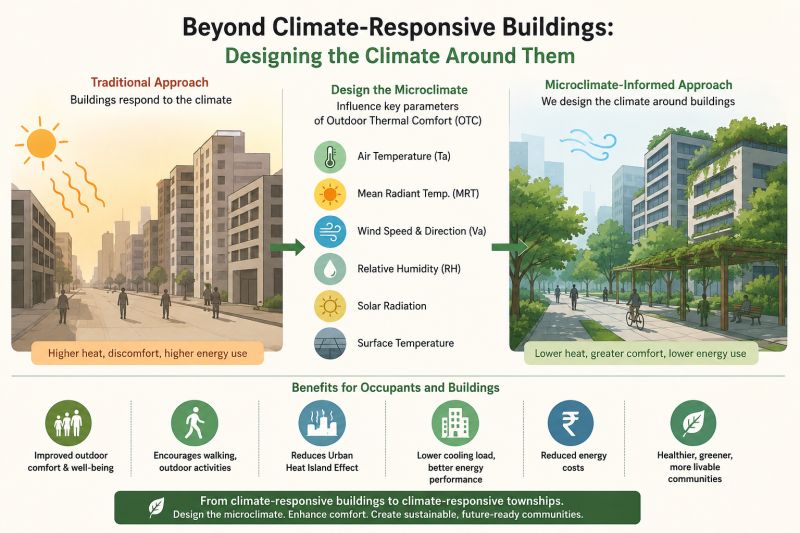
This approach works well for individual buildings. But at the scale of a township or urban district, perhaps we should ask a different question:
“How do we create a better built environment for buildings and people?”
Instead of only adapting buildings to the existing climate, we can intentionally shape the urban environment itself. Through thoughtful site planning, landscape design, urban form, and passive design strategies, we can influence the key factors that determine Outdoor Thermal Comfort (OTC):
🌳 Air Temperature (Ta)
☀️ Mean Radiant Temperature (MRT)
💨 Wind Speed & Direction (Va)
🌿 Relative Humidity (RH)
🌞 Solar Radiation
🛣️ Surface Temperature
Improving these parameters creates cooler, healthier, and more comfortable outdoor spaces across pedestrian streets, parks, plazas, courtyards, and public gathering areas.
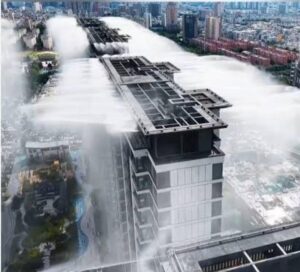
We’re also beginning to see innovative approaches around the world. In China, some developments have experimented with rooftop misting (spray) systems that release fine water droplets to cool the surrounding air through evaporative cooling. While such systems require careful consideration of water use, maintenance, and climate suitability, they demonstrate that the microclimate around buildings can be actively engineered not just passively endured.
The benefits extend well beyond occupant comfort. A cooler microclimate can:
✅ Reduce heat stress and improve public health
✅ Encourage walking, cycling, and outdoor activities
✅ Mitigate the Urban Heat Island (UHI) effect
✅ Lower surrounding building cooling loads and energy consumption
✅ Improve the overall livability and resilience of urban developments
The future of sustainable design may not be limited to climate-responsive buildings.
It may be about creating climate-responsive townships, where the urban microclimate is designed as deliberately as the buildings themselves integrating landscape, water, materials, shading, airflow, and innovative cooling technologies to create healthier cities for everyone.
ATCHAYA T| Confederation of Indian Industry |CREDAI National |CII – Indian Green Building Council (IGBC) |GBCI India |U.S. Green Building Council |GRIHA Council |National Association of Students of Architecture (NASA India)