
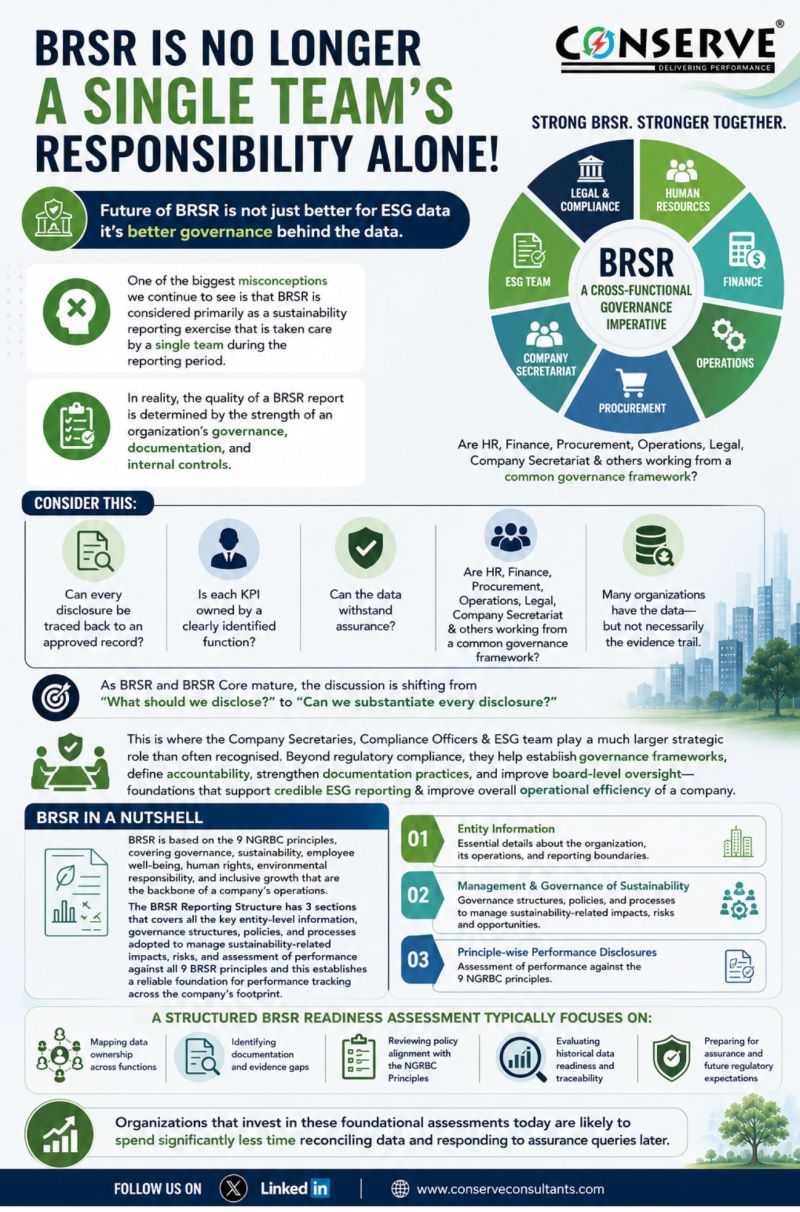
Future of BRSR is not just better for ESG data it’s better governance behind the data.
One of the biggest misconceptions we continue to see is that BRSR is considered primarily as a sustainability reporting exercise that is taken care by a single team during the reporting period.
In reality, the quality of a BRSR report is determined by the strength of an organization’s governance, documentation, and internal controls.
Consider this:
Can every disclosure be traced back to an approved record?
Is each KPI owned by a clearly identified function?
Can the data withstand assurance?
Are HR, Finance, Procurement, Operations, Legal, Company Secretariat & others working from a common governance framework?
Many organizations have the data but not necessarily the evidence trail.
As BRSR and BRSR Core mature, the discussion is shifting from “What should we disclose?” to “Can we substantiate every disclosure?”
This is where the Company Secretaries, Compliance Officers & ESG team play a much larger strategic role than often recognised. Beyond regulatory compliance, they help establish governance frameworks, define accountability, strengthen documentation practices, and improve board-level oversight foundations that support credible ESG reporting & improve overall operational efficiency of a company.
BRSR in a nutshell: BRSR is based on the 9 NGRBC principles, covering governance, sustainability, employee well-being, human rights, environmental responsibility, and inclusive growth that are the backbone of a company’s operations.
The BRSR Reporting Structure has 3 sections that covers all the key entity-level information, governance structures, policies, and processes adopted to manage sustainability-related impacts, risks, and assessment of performance against the all 9 BRSR principles and this establishes a reliable foundation for performance tracking across the company’s footprint.
A structured BRSR readiness assessment typically focuses on:
✔ Mapping data ownership across functions
✔ Identifying documentation and evidence gaps
✔ Reviewing policy alignment with the NGRBC Principles
✔ Evaluating historical data readiness and traceability
✔ Preparing for assurance and future regulatory expectations
Organizations that invest in these foundational assessments today are likely to spend significantly less time reconciling data and responding to assurance queries later.

