
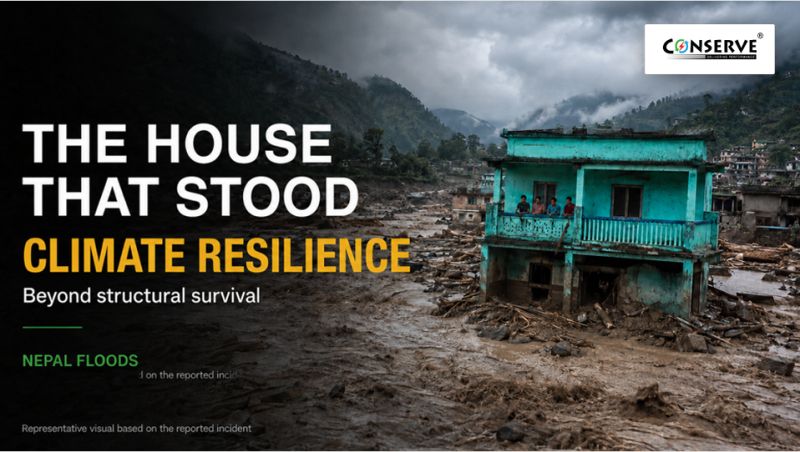
The turquoise house that remained standing during the recent Nepal floods has attracted widespread attention.
Most discussions have focused on one question:
“How did this structure survive when so many others were severely damaged?”
Its construction, foundation, elevation and location may have contributed. Without a detailed investigation, however, the exact reasons cannot be determined from the footage alone.
From a sustainability perspective, we should ask an earlier question:
“Were future climate hazards understood before deciding where and how to build?”
A building may conserve energy and water and use low-carbon materials. But if it is unprepared for the conditions it may face during its lifetime, its long term sustainability remains at risk.
Climate resilience requires project teams to understand:
01 | Hazard: What events could affect the project?
02 | Exposure: Who and what could be affected?
03 | Sensitivity: How severe could the consequences be?
04 | Adaptive Capacity: Can the building respond and recover?
05 | Vulnerability and Risk: What is the likelihood and impact?
This approach is now reflected in ESG and Green Building Certifications: Climate Resilience Assessment.
It is a mandatory prerequisite. Organizations and projects must identify observed, projected and future natural hazards, select at least two priority hazards, assess their risks and consider relevant design strategies.
We do not know whether this house was designed for a flood of this scale or whether future climate risks were considered.
Its survival alone does not prove complete climate resilience. We do not know whether it remained habitable, retained essential services or could quickly return to normal use.
Even so, it offers a powerful real world illustration of what resilience seeks to achieve: protecting lives, reducing damage, preserving materials and embodied carbon, avoiding waste and supporting faster recovery.
A sustainable building should not only reduce its impact on the environment. It should also be prepared for the environmental conditions it may experience throughout its life.
At Conserve Consultants, we view climate resilience assessment as more than an ESG or a certification requirement. We help project teams identify hazards, evaluate exposure and vulnerability, prioritise risks and translate the findings into informed planning, design and operational decisions.
Our objective is to help buildings perform efficiently today while remaining safer, more reliable and valuable under a changing climate.
Efficiency prepares a building for everyday performance. Resilience prepares it for an uncertain future.
Content by Dhinakaran K, Engineer, Conserve Consultants.

