
What Are Ecolabels and Why Do They Matter?
Environmental labels are broadly categorized into 3 types based on international standards.
Type I Ecolabel – Certification-Based Sustainability Label
(e.g., GreenPro, GRIHA PC)
Type I ecolabels are third-party certifications that verify that a product meets predefined environmental performance criteria within its category. These labels typically evaluate multiple environmental aspects such as Resource efficiency, Responsible raw material sourcing, Reduced environmental impact during production, Health and safety aspects of materials, and compliance with sustainability standards. Programs such as GreenPro, GRIHA PC, Eco mark, and EU Ecolabels fall within this category.
Products certified under Type I ecolabel programs are generally recognized as environmentally preferable products within their category. For construction materials, such labels help manufacturers demonstrate that their products meet recognized sustainability benchmarks.
Type II Ecolabel – Verified Environmental Claims
(e.g., Recycled Content)
Type II ecolabels focus on verified environmental attributes of a product. These may include claims such as Recycled content, Resource efficiency, Reduced environmental impact, and sustainable manufacturing practices.
Programs such as in India fall within this category. They verify product-level environmental claims against defined sustainability criteria. For manufacturers, Type II labels provide an accessible pathway to demonstrate responsible product design and manufacturing practices.
Type III Ecolabel – Environmental Product Declarations (EPDs)
Type III ecolabels provide quantified environmental impact data based on Life Cycle Assessment.
An Environmental Product Declaration (EPD) reports environmental impacts across different stages of a product’s life cycle, including Raw material extraction, Manufacturing, Transport, Use phase (where applicable), End-of-life
Unlike Type I or Type II labels, which communicate sustainability compliance or claims, EPDs focus on transparent environmental performance data. These allow architects, developers, and sustainability consultants to compare products based on measurable lifecycle impacts.
Why Combining Ecolabels Creates Stronger Market Value
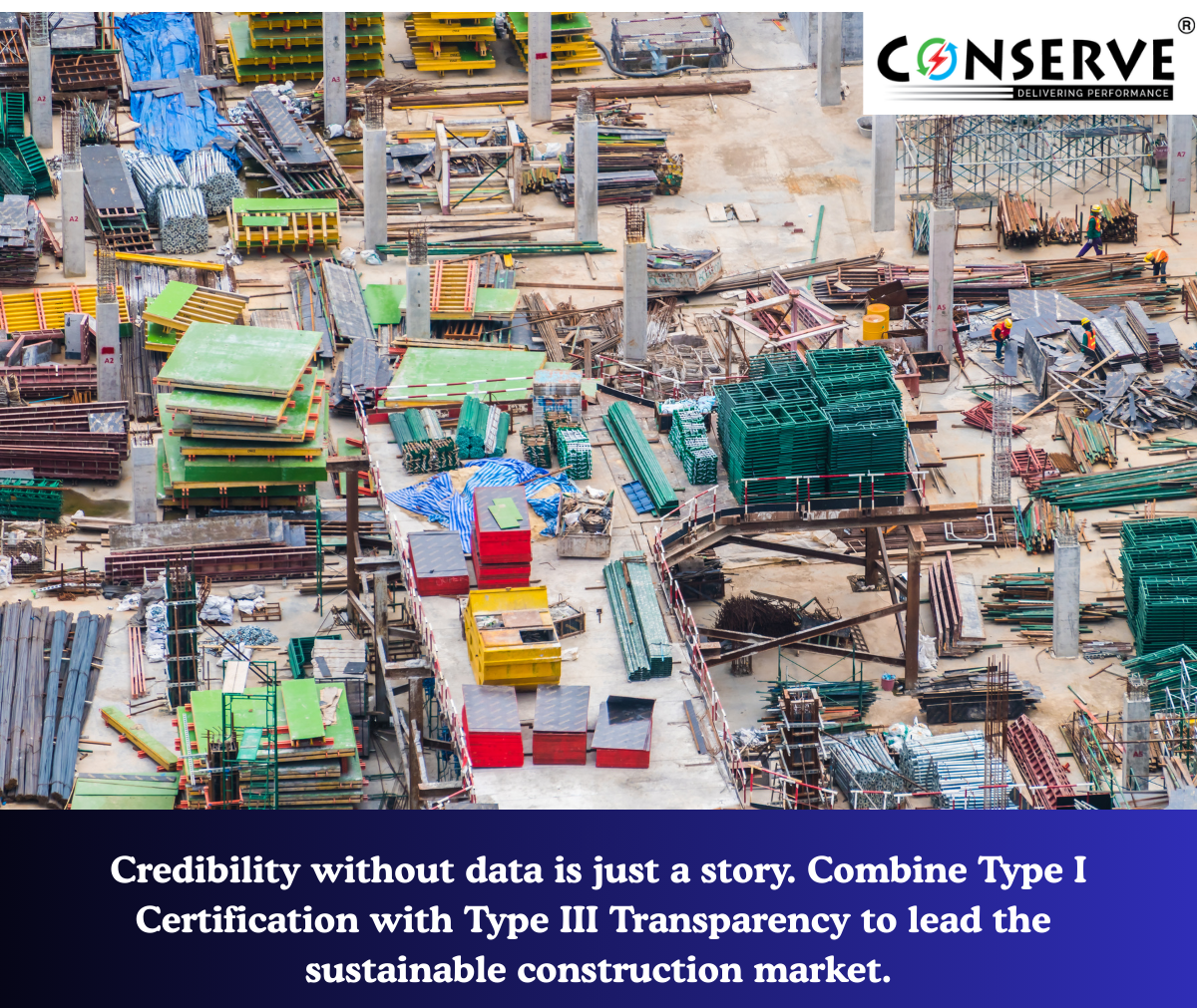
Each ecolabel type communicates sustainability in a different way. When combined, they create a more complete environmental narrative about the product.
1. Certification + Transparency
Type I and Type II ecolabels demonstrate that a product meets recognized sustainability criteria and responsible manufacturing practices. Type III ecolabels provide transparent, quantified environmental data.
Together they answer two important questions for buyers and end-users:
- Is the product environmentally responsible?
- What is its measurable environmental impact?
This dual credibility is increasingly important in sustainable construction markets.
2. Stronger Positioning in Green Building Projects
Green building projects often evaluate materials based on both sustainability certification and environmental impact data.
Type I and Type II labels help demonstrate compliance with sustainability requirements and responsible sourcing.
EPDs provide lifecycle environmental data that can support embodied carbon assessments and lifecycle analyses.
Products with both certifications and environmental declarations are more attractive for sustainable construction projects.
3. Better Engagement with AEC stakeholders
Architects, Consultants, and Project teams evaluate materials at different stages of the design process. During early material selection, ecolabels help identify environmentally preferable products.
During detailed sustainability analysis, lifecycle data from EPDs becomes critical for embodied carbon calculations and environmental assessments. Products supported by both ecolabels and environmental declarations remain relevant throughout the design and specification process.
Importantly, Type I, Type II, and Type III ecolabels are increasingly recognized and referenced in Green building frameworks such as LEED, IGBC, and GRIHA for the use of environmentally certified products and transparent environmental data. As embodied carbon and material transparency become more important in construction, ecolabels are moving from optional credentials to expected documentation for products used in green building projects.
4. Improved Procurement Credibility
Procurement teams increasingly evaluate suppliers based on sustainability performance and environmental transparency.
Type I and Type II ecolabels signal that a product meets recognized environmental criteria. Type III ecolabels provide verified data that supports environmental claims.
Manufacturers that provide both certification and quantified environmental data reduce uncertainty for buyers and strengthen procurement confidence.
5. Valuable Internal Sustainability Insights
The process of achieving ecolabel certifications and developing EPDs can also provide valuable insights for manufacturers.
Certification assessments highlight opportunities for improving resource efficiency and environmental performance. LCA used in EPD development identify emission hotspots across raw materials, production processes, and logistics.
Together, they provide a more holistic understanding of product sustainability performance.
A Strategic Pathway for Manufacturers
For many construction product manufacturers, a progressive sustainability pathway can be starting with Ecolabel Certification such as Green Pro or GRIHA PC that demonstrate responsible product design and manufacturing practices. Then publishing an EPD with third-party verified environmental data for the product through LCA across the product lifecycle stages allows manufacturers to move from sustainability claims toward measurable environmental transparency.
Future-Ready Your Products with Conserve Consultants
The construction sector is moving toward greater environmental transparency and accountability. Developers, architects, and procurement teams increasingly expect both credible sustainability certifications and quantified environmental impact data. Manufacturers who integrate these approaches will be better positioned for the next phase of sustainable construction markets in India, where environmental credibility, transparency, and data-driven decision-making will define competitive advantage.
Ready to demystify ecolabels for your products?
Whether you're starting with GreenPro certification or ready to publish your first Environmental Product Declaration, our team at Conserve Consultants can guide you through every step.
Contact Us Today for a Consultation and discover how we can help you build credibility through certification and transparency. info@conserveconsultants.com or WhatsApp +9190030 97071

